THE QUESTION THAT STARTED IT ALL
A TRUE STORY
In early 2026, we went a place where we used to live many years ago. My wife suggested we sneak a peek at our old house, the one where we had our first child and lot of memories.
When my wife suggested to visit the old house, my younger one immediately asked: “I don’t remember this house. Where was I at that time?”
And my older one chimed right in: “Yeah Dad, where was she at that time?”
I went quiet for a moment. My younger one wasn’t even born when we lived there. Trying to figure out what to answer, I suddenly realised the question was far bigger than it sounded. Where was she at that time? Where are any of us before we are born? And if we didn’t exist, how did we come from nothing? That doesn’t make any sense.
My kids, without knowing it, had just asked the question that philosophers, saints, and scientists have been wrestling with for millennia. Let me take you down the rabbit hole I fell into that day.
FOLLOWING THE CHAIN OF QUESTIONS
Following the initial question, we began a conversation that kept unraveling, every answer opening two new questions.
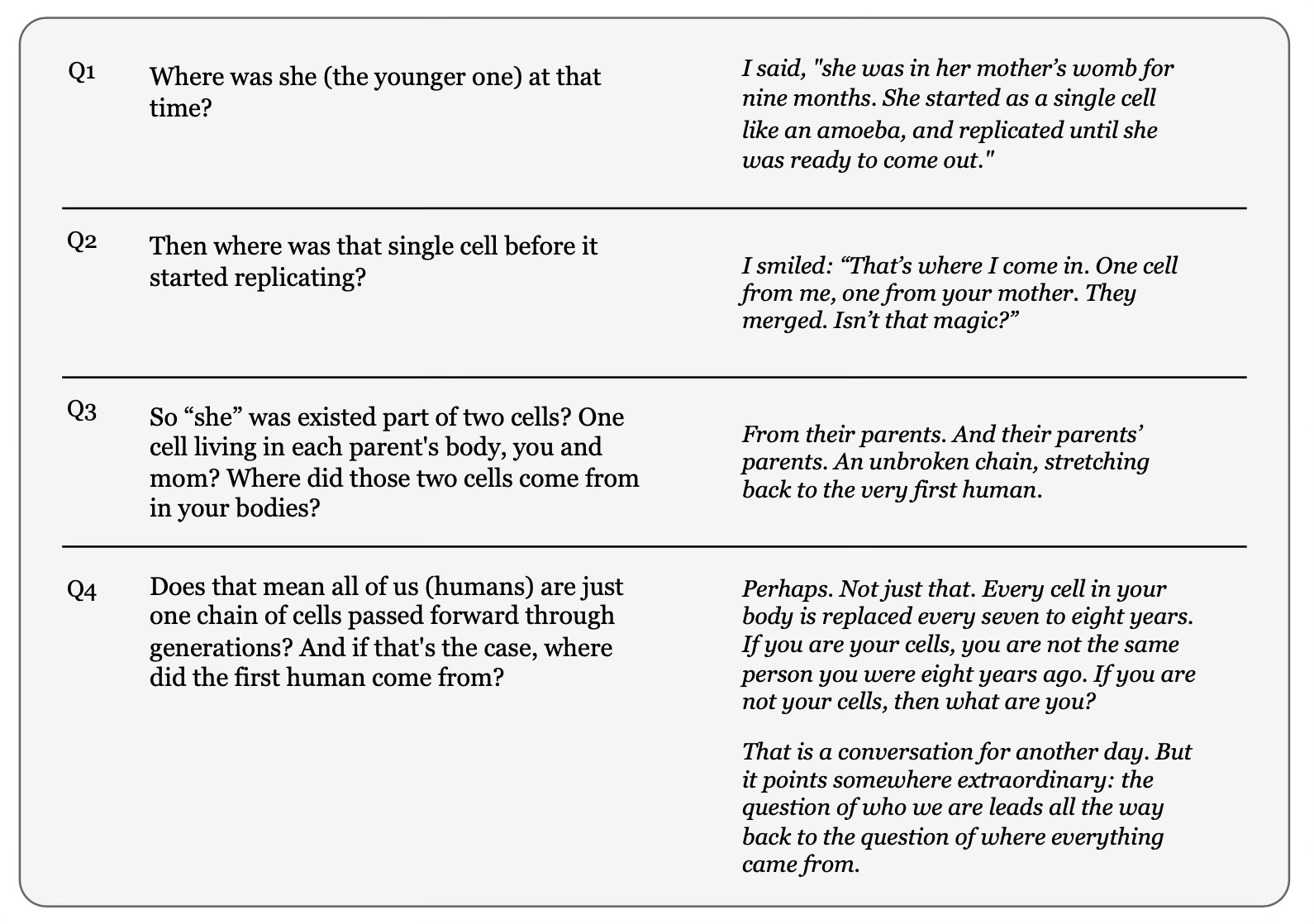
Every answer was a door. Behind every door: two more doors. This is not a sign that the question is unanswerable. It is a sign that the question is alive.
A THOUGHT EXPERIMENT: THE MEMORY PROBLEM
Here is something that stopped me cold. I have no memory of being one week old. By that logic, did my life only “really” begin when I started forming memories? That seems obviously wrong. My parents and neighbors were witnessing my existence the whole time. Their experience of me was real, even when I had no experience of myself.
Which means: existence has nothing to do with your experience of it.
And if that’s true for the first weeks of your life, it might also be true for whatever came before your birth. You not remembering something does not mean it didn’t happen to you. It means your memory that thin, unreliable instrument simply wasn’t there yet.
“We don’t remember things even from when we were one week old. Does that mean our life only started when we started remembering? How can that be true?”
YOU ARE NOT THE RIVER — YOU ARE THE PATTERN OF FLOW
Before we get to what the philosophers say, let me offer two analogies that I keep coming back to, because I think they’re more precise than they first appear.
Think of a company, call it XYZ Corp. Over twenty years, everything about it changes: the name, the CEO, the employees, the product, the offices, the strategy. And yet we say without hesitation: it’s still XYZ Corp. Something persists. Some coherent pattern of purpose and continuity survives every change.
Now think of a super smart AI computer. AI Computer that knows reasoning, can do critical thinking, better than human at math, science & language, ran by energy (electricity). No different in next few years than any other human. Swap out memory, processing power, the hard drive, the screen, even the operating system. It’s still same AI computer. No different than human in our analogy.
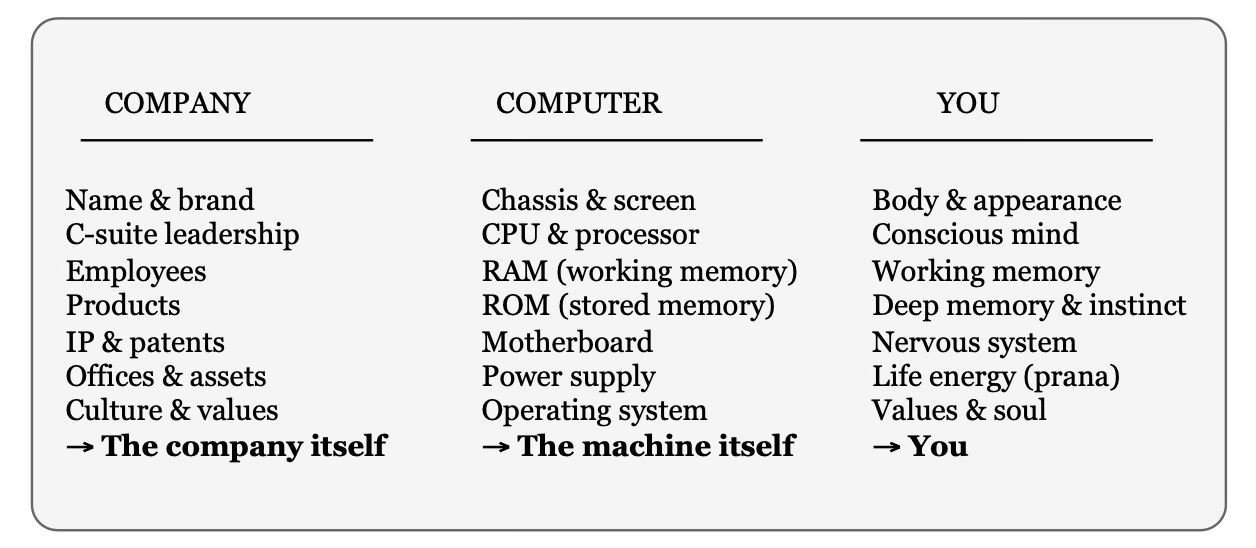
As XYZ Corp is not its office building, you are not your body. As computer is not its memory or electricity, you are not your mind, your memories, your soul, or your energy. You are the coherent, living system that emerges when all of those components run together. Change every component; the system can still be you. Lose the coherence that ties them together, and it doesn’t matter what components remain.
WHAT THE WISDOM TRADITIONS SAY
Here is the remarkable thing: every major civilization on earth independently, across centuries has tried to answer my daughter’s question. They all disagree on the details. But they all circle the same strange truth.
HINDUISM · THE UPANISHADS & VEDANTA · ~800 BCE
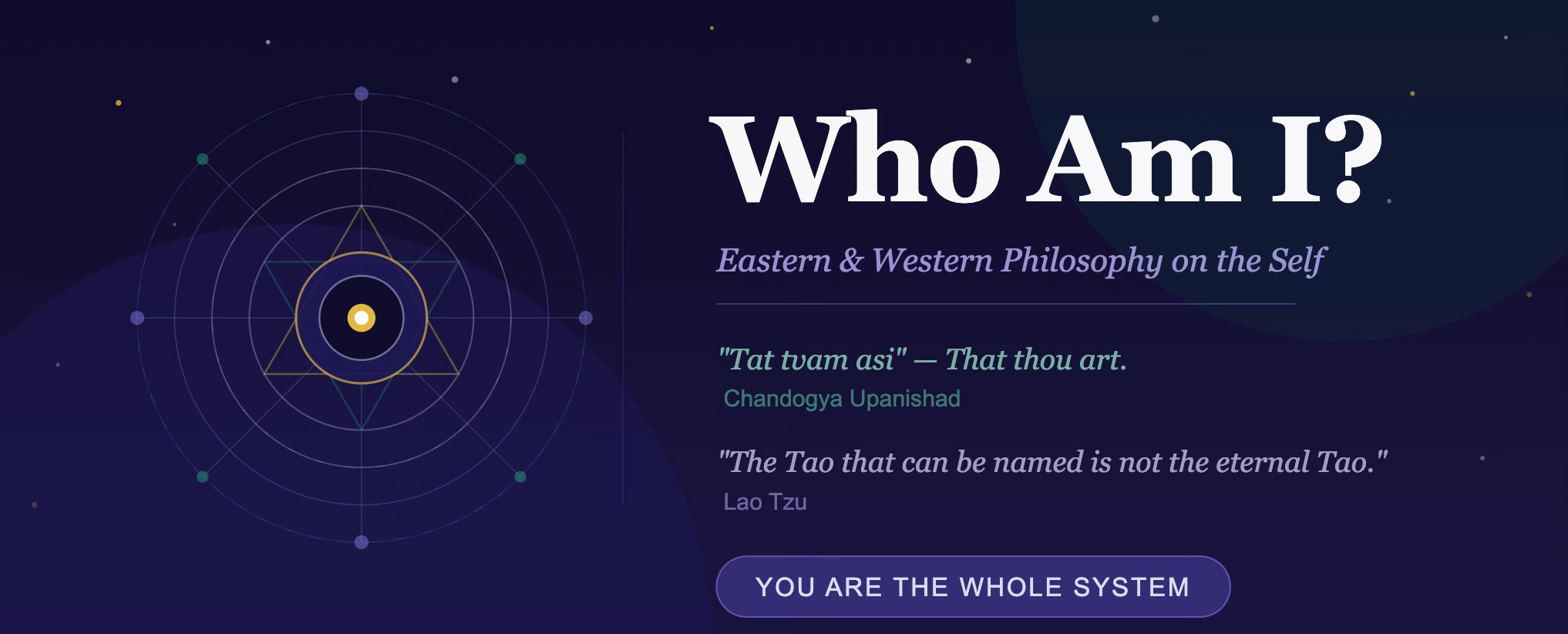
“Tat tvam asi” — That thou art.
The Atman, your individual self, existed before this birth and continues after death. It is eternal. But here is the twist: the Upanishads don’t stop there. They say the Atman (the self) and Brahman (the creator and creation) are the universal consciousness and are not two different things. You are not a fragment of the universe trying to understand itself. You are the universe understanding itself. The company analogy breaks down beautifully here: XYZ Corp thinks it’s one company. The Upanishads say every company is the same company, playing different roles in the same story.
BUDDHISM · ANATTA (NO-SELF) · ~500 BCE
“In the seen, there is only the seen.”
The Buddha’s doctrine of Anatta doesn’t say you don’t exist. It says there is no fixed, permanent self hiding behind your experiences. What you call “I” is a dynamic cluster of five aggregates; form (body), sensation (energy), perception (mind interpreting), mental formations (personality), and consciousness. None of them alone is you. All of them running together? That’s the person. This was discovered 2,500 years before computers existed, tho very close to the computer model. Before birth, these aggregates simply hadn’t assembled yet. After death, they dissolve. In between: you.
TAOISM · LAO TZU · ~6TH CENTURY BCE
“The Tao that can be named is not the eternal Tao.”
Before birth, you were part of the Dao — the fundamental, unnameable source of all reality. Individual existence is a temporary manifestation, like a wave that rises from the ocean and returns to it. You didn’t come from nothing. You came from everything. And you will return to it. The Taoist answer to my daughter’s question: She was always here, she just didn’t have yet her name.
ADVAITA VEDANTA · ADI SHANKARACHARYA · ~8TH CENTURY CE
“Brahma satyam, jagan mithya.” — Brahman alone is real; the world of appearances is superimposition.
Shankara pushed the Upanishadic insight further: our sense of being a separate, bounded individual is like seeing a snake in a coiled rope at dusk — a misreading of what’s really there. Remove the distortion, and you don’t find nothing. You find something much larger than the person you thought you were.
WESTERN MATERIALISM · PHYSICALISM · MODERN
“Before birth, there was no brain — hence no mind — hence no existence.”
But even this view has a crack in it. When my kid was two separate cells, one in her father and one in my mother, neither cell had a brain. Yet each had the intelligence to find the other, merge, and begin replicating with extraordinary precision. Where did that intelligence live, if not in a brain? The materialist answer assumes intelligence requires a brain. But the cell-level behavior that creates the brain suggests something more mysterious is at work.
WHAT THIS MEANS FOR HOW YOU LIVE
If you are a system and not a fixed thing, then a few things follow that are genuinely liberating.
THREE THINGS THAT CHANGE WHEN YOU SEE YOURSELF AS A SYSTEM
Your components can change without you ending. A health crisis, a loss of faith, a career collapse, these are hardware upgrades or software patches, not system failures. XYZ Corp survives the restructuring. You survive the transformation.
You can observe your own components. You can watch a thought arise and pass, which means you are not the thought. Feel an emotion without becoming it, which means you are not the emotion. The CEO reads the quarterly report; they are not the quarterly report.
Your identity is something you participate in building. A company with no direction drifts. A computer with no operating system is expensive metal. The question “who am I?” is not passive discovery but it is active authorship.
BACK TO THE OLD HOUSE
We did drive past it. The house looked smaller than I remembered. The tree in the front yard had grown enormous. The family inside had no idea we’d once made breakfast in their kitchen, brought a newborn home through that door, had arguments and reconciliations and quiet Sunday mornings in those rooms.
My younger one pressed her face against the car window and asked: “Was this really our house?”
Yes and no, I wanted to say. The house is the same address. The people inside are completely different. The us who lived there younger, tireder, newer to all of this don’t quite exist anymore either. But something persists. The memory. The story. The pattern that connects who we were then to who we are now.
That persistent pattern, the thing that makes you you across all the years and changes is what every tradition is trying to name. The Hindus call it Atman. The Buddhists call it the stream of consciousness. The Taoists call it your nature. You might call it yourself.
“The question ‘Who am I?’ is not a problem to be solved. It is a direction to move in — and the moving itself is the answer.”— adapted from Ramana Maharshi
You are not your body, your mind, your soul, your memories, or your energy. You are what happens when all of them show up together, and whatever keeps making that decision, again and again, across every version of yourself you’ve ever been.
My daughter’s question, asked from the back seat of a car on a quiet afternoon, has no final answer. But it has a direction. And following it, honestly, is the most important thing any of us can do.
You are not the body, the mind, the soul, or the energy.
You are the coherent, living pattern that holds them all.
You are the company that outlasts every reorganization.
You are the question that keeps asking itself.
— And you always have been